



The Treasures at Firle – Part One
Many of the decorative artefacts at Firle Place offer a vivid reflection of eighteenth-century taste, ambition, and craftsmanship. Beyond painting, objects of design played an equally vital role in shaping the cultural identity of elite households. Three exceptional works – the Melbourne Cabinets, the Sèvres Melbourne Dessert Service, and a grand crystal chandelier attributed to William Parker – demonstrate how artistry and imagination converged to create statements of status and refinement.
In this article, we take a look at three of the most interesting artefacts that visitors to Firle Place and event attendees will have the opportunity to view.
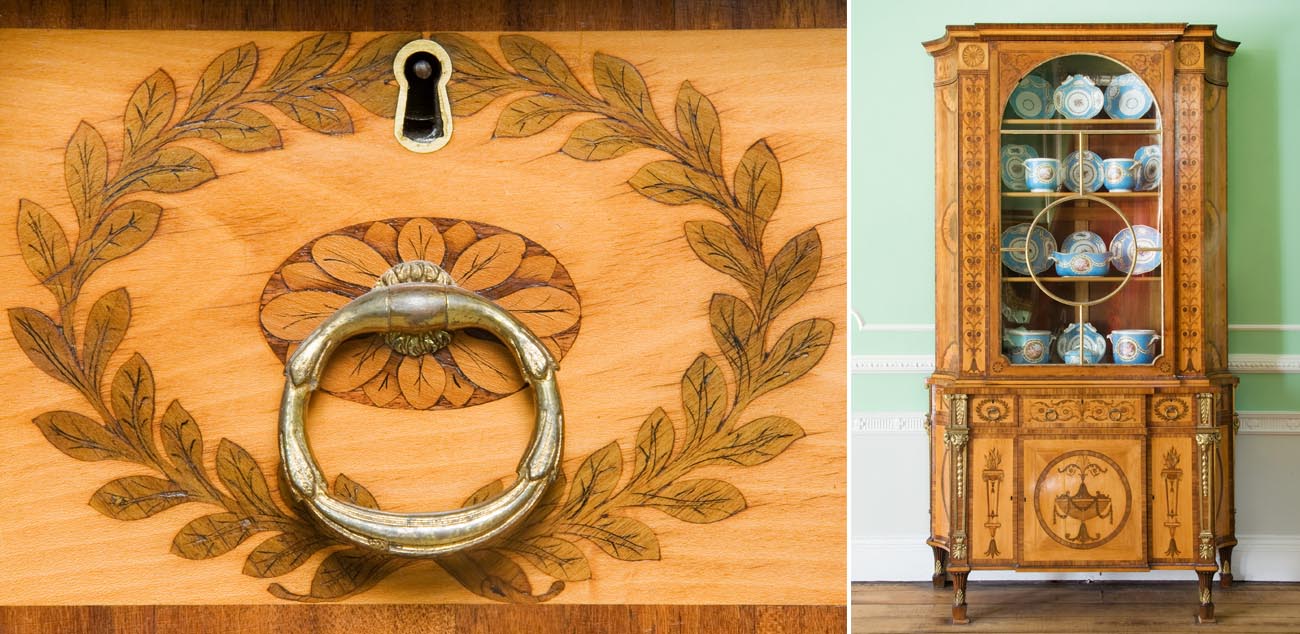
The Melbourne Cabinets
Thomas Chippendale (1718-1779)
The Melbourne Cabinets, commissioned around 1773 from Thomas Chippendale by Peniston Lamb, 1st Viscount Melbourne, stand among the most remarkable achievements of eighteenth-century furniture design. These cabinets exemplify the Neoclassical style that dominated the period, adorned with intricate ornamentation that would originally have been vividly coloured, set against an unusual holly veneer. When new, this choice of material created a strikingly bright, almost luminous surface, enhancing the decorative motifs applied across it.
The craftsmanship extends beyond the exterior: the interiors are lined with rich mahogany, while the gleaming ormolu mounts testify to the expense lavished upon their creation. Though their exact cost is unknown, comparable commissions by Chippendale were among the most expensive of their time, underscoring the significance of this order.
The cabinets are not merely functional objects but declarations of taste and wealth, embodying the aspirations of a patron eager to align himself with the most fashionable artistic currents of his age.
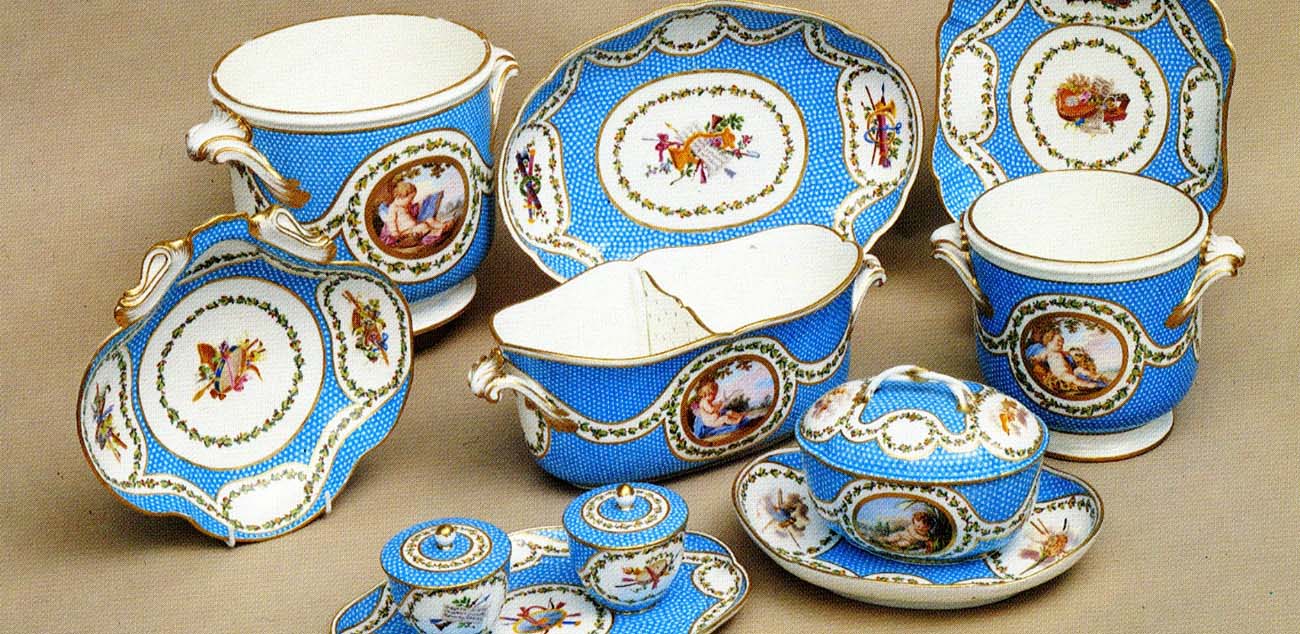
Sèvres Melbourne Dessert Service
Equally impressive in scale and ambition is the Sèvres Melbourne Dessert Service, an elaborate 80-piece porcelain set commissioned in 1771 from the renowned Sèvres porcelain factory. Delivered via Paris at considerable expense, the service would have made an immediate and dazzling impression, being only the second of its kind ordered directly by an English patron. Its design was strikingly modern: a turquoise-blue ground scattered with white roundels, a style introduced only months earlier for Madame du Barry. Within these decorative fields, finely painted cartouches depict scenes of art, music, and love, reflecting both classical themes and a sensitivity to the tastes of its owner. One particularly evocative image, a putto reading from Shakespeare’s Hamlet, suggests a deliberate effort to appeal to British cultural pride.
Despite its intended function, the pristine condition of the service indicates it was rarely used, instead serving as a display of sophistication and cosmopolitan taste. Its later admiration by Queen Victoria further attests to its enduring allure and significance.
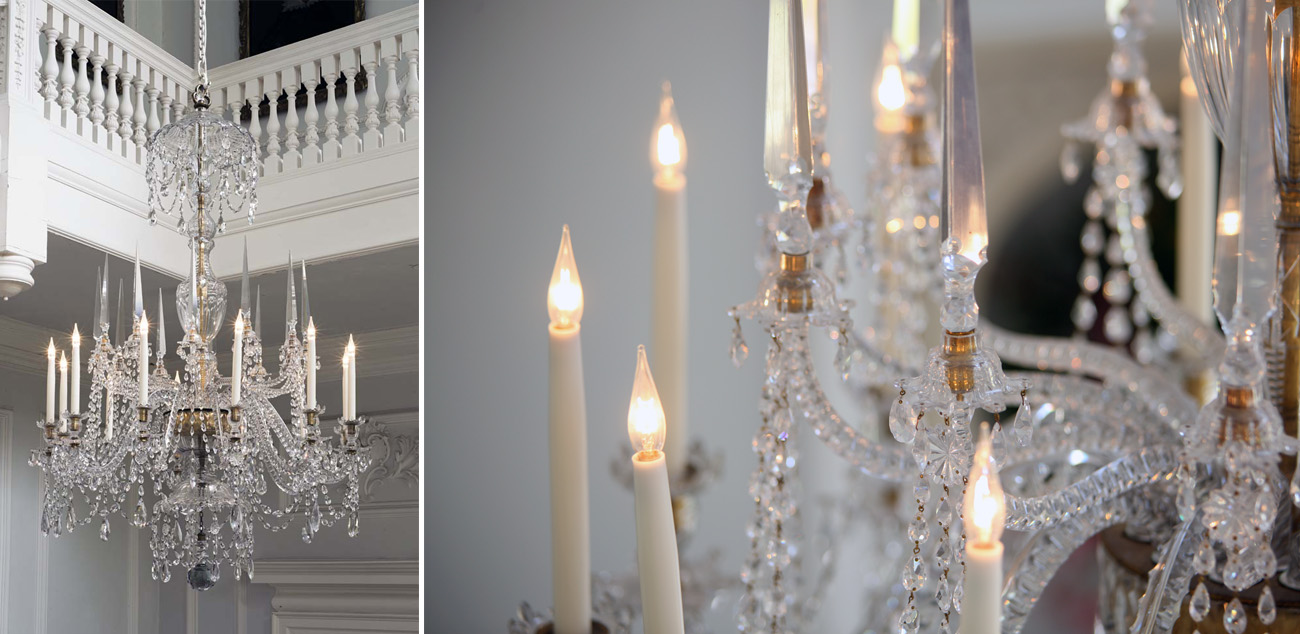
Crystal Chandelier
Attributed to William Parker (active 1772-1784)
Completing this trio is a magnificent Crystal Chandelier, attributed to William Parker and dating from the late eighteenth century. This stunning chandelier captures the elegance and balance characteristic of Neoclassical design, with its central shaft incorporating a graceful urn form, a motif inspired by antiquity and widely popular in the period. The chandelier’s upper arms rise into slender spikes, while the delicately shaped drip pans and nozzles reflect a style reminiscent of Van Dyck’s aesthetic influence.
The inclusion of canopies at both the top and bottom further aligns it with contemporary architectural trends, particularly those associated with Robert Adam, whose designs helped define the visual language of the era. Light, refracted through its crystal elements, animates Firle’s Little Hall with a soft, shimmering brilliance, transforming the space into a welcoming embrace as much as illuminating it. Comparable examples, such as one held at Paxton House, reinforce its place within a broader tradition of refined decorative lighting.
Together, these works exemplify the artistry and ambition that defined elite interiors in the eighteenth century. Each object transcends its practical purpose, becoming instead a powerful expression of aesthetic vision, cultural engagement, and enduring legacy. Visitors and event attendees at Firle Place will have the opportunity to enjoy the occasion alongside seeing some of the most interesting artefacts in southern England.