



The Treasures at Firle – Part Two
Many of the decorative artefacts at Firle Place offer a vivid reflection of eighteenth-century taste, ambition, and craftsmanship. Beyond painting, objects of design played an equally vital role in shaping the cultural identity of elite households. Three exceptional works – the Melbourne Cabinets, the Sèvres Melbourne Dessert Service, and a grand crystal chandelier attributed to William Parker – demonstrate how artistry and imagination converged to create statements of status and refinement.
In this article, we take a look at three of the most interesting artefacts that visitors to Firle Place and event attendees will have the opportunity to view.
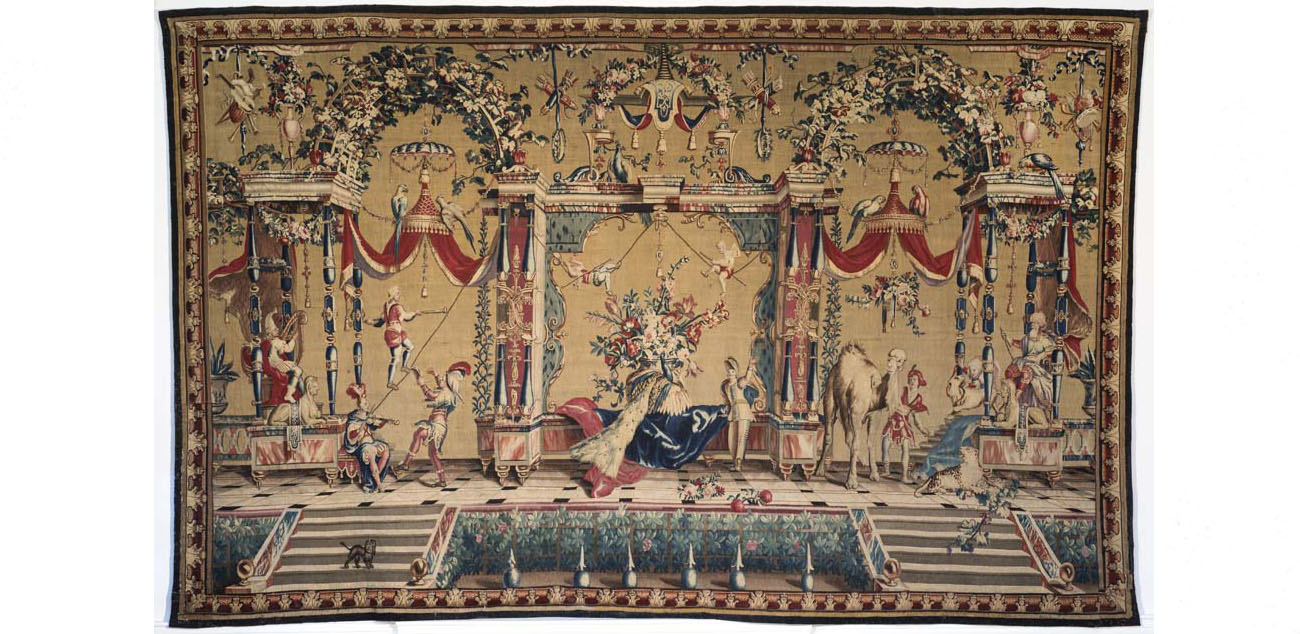
Two Beauvais Tapestries
The Two Beauvais Tapestries originate from the celebrated Beauvais Manufactory, established in 1664 under the direction of Jean-Baptiste Colbert to rival the great Flemish weaving centres. These works belong to the widely admired ‘Grotesque’ series, produced between 1688 and 1732 and designed by Jean Baptiste Monnoyer. Their intricate compositions draw upon a rich blend of influences, from the ornamental inventions of Jean Berain to the lively spectacle of Parisian theatre
Both tapestries depict the same scene, known as The Camel, yet subtle variations between them reveal the adaptability of the design and the creative latitude afforded to the weavers. Animated by acrobats and theatrical figures, characters that would have been familiar sights on the streets of Paris, the compositions possess a whimsical vitality that contrasts with their formal elegance. These textiles are not merely decorative hangings but vibrant reflections of contemporary culture, translating performance and ornament into richly woven form.
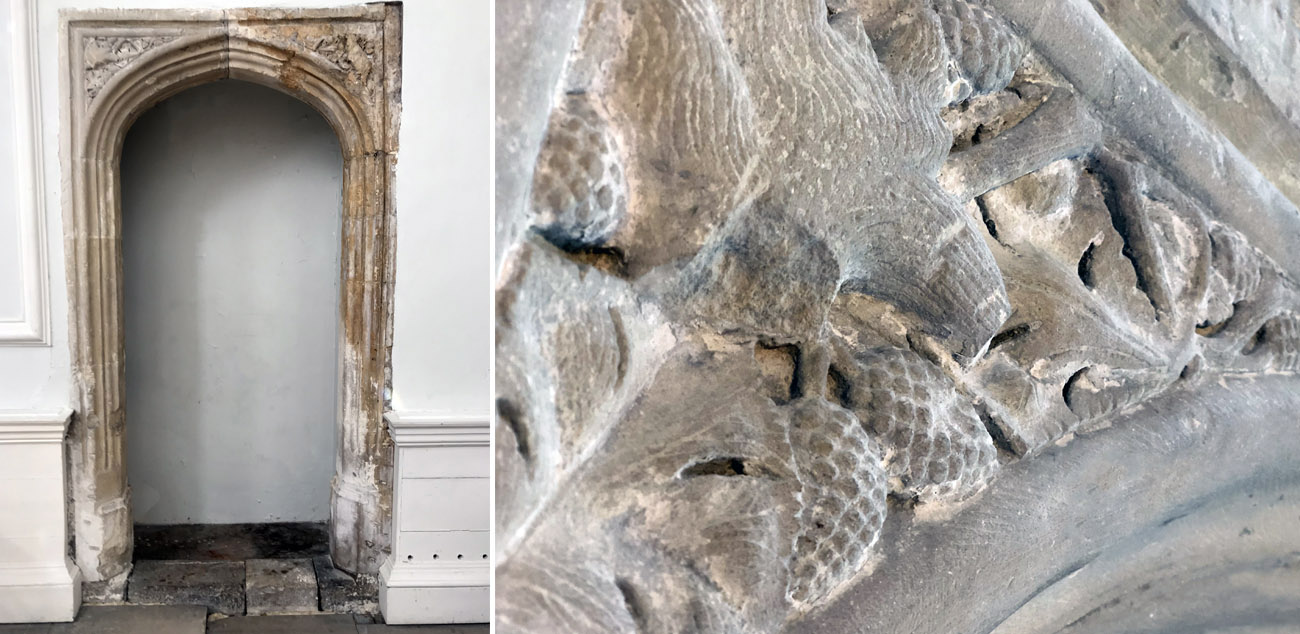
Tudor Doorway
Equally evocative, though rooted in a far earlier period, is the Tudor Doorway, a remarkable survival that bridges medieval and Tudor histories. Installed during the construction of Firle Place by Sir John Gage in the late 1530s, the doorway itself predates the house, having likely been salvaged from the nearby Cluniac Priory of St Pancras. This priory, founded in the eleventh century, was dismantled in 1537 during the Dissolution of the Monasteries, providing a source of finely worked Caen stone for new projects.
Recontextualised within Firle, the doorway was adapted to reflect its new setting, bearing the heraldic symbols of Sir John Gage and his wife, Philippa Guldeford. Its presence speaks to a practice common in the period: the reuse of monastic materials to assert continuity, authority, and lineage. Once possibly leading into a chapel now lost to later alterations, the doorway endures as a tangible link between sacred and domestic space, carrying echoes of both devotion and reinvention.
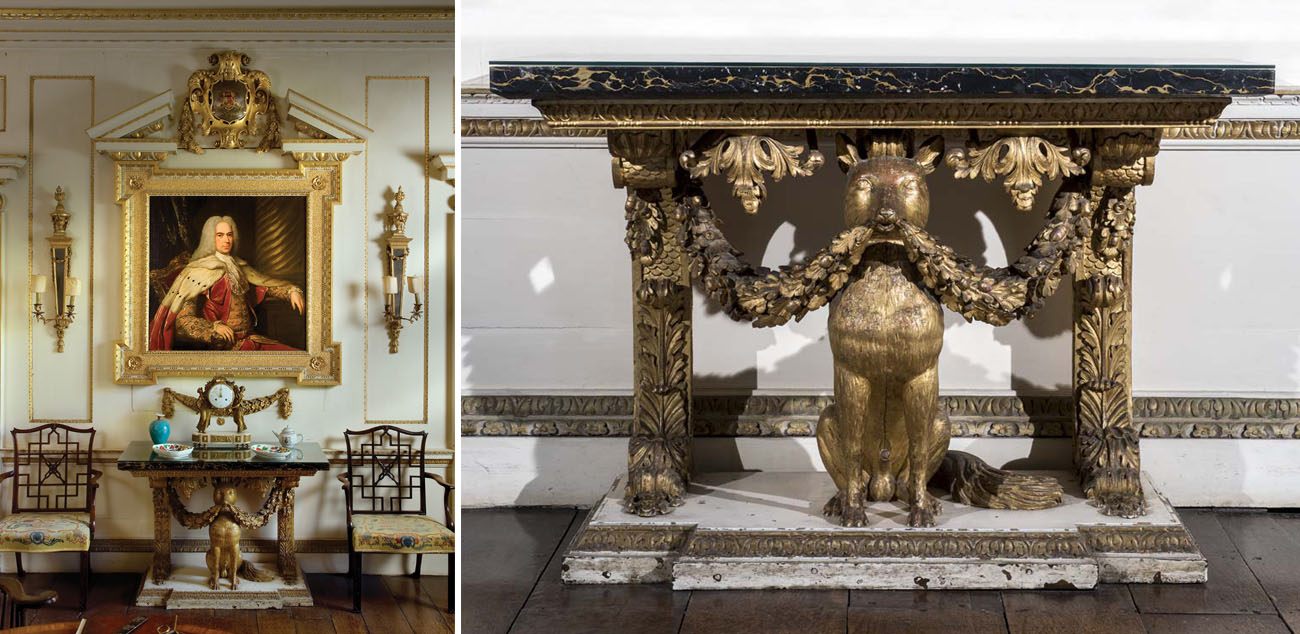
Pair of George II Console Tables with Fox Supports
Completing this trio are the Pair of George II Console Tables with Fox Supports, objects of both elegance and intrigue. Crafted in the Georgian period, these gilded tables feature striking fox supports beneath richly veined Portor marble tops, an unusual and playful motif that sets them apart from more conventional designs. Their precise origin remains uncertain, though parallels with a similar pair at Stourhead suggest a shared design lineage.
The tables’ proportions indicate they were not originally intended for their present location, implying a history of relocation, possibly from other family residences such as Highmeadow or a London townhouse. Stylistically, they bear resemblance to the work of John Boson, an associate of William Kent, whose refined carving and decorative sensibility defined much of the period’s furniture. Though few of Boson’s works survive, these tables echo the sophistication attributed to his craftsmanship. As both functional furnishings and sculptural statements, they encapsulate the inventive spirit of eighteenth-century design.
These works reveal the richness and diversity of artistic expression embedded within Firle Place. Whether woven, carved, or constructed, each object offers a distinct narrative of cultural exchange, historical upheaval, and enduring artistry, inviting the viewer to engage with the past in both tangible and imaginative ways. In this article, we take a look at three of the most interesting artefacts that visitors to Firle Place and event attendees will have the opportunity to view.